

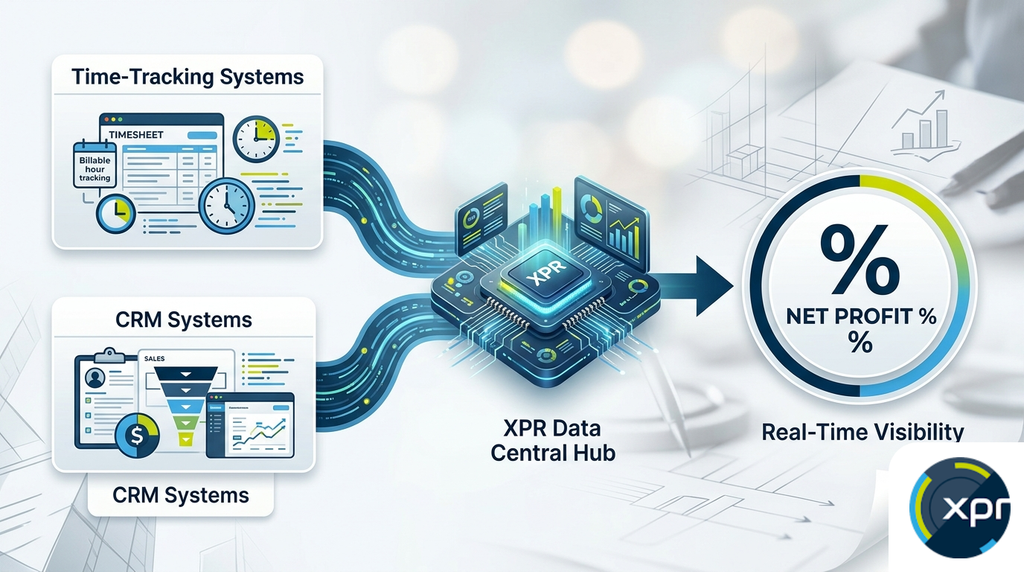
Work in progress (WIP) is the value of work performed but not yet billed, and it is the earliest reliable warning that a firm’s cash position is deteriorating. Reviewed at month end, WIP tells you about problems that are already three weeks old. Reviewed live, alongside net profit by project and practice group, it tells you which engagements to intervene in this week. XPR Data unifies time and billing, practice management and finance into one live dashboard for a flat fee. Book a Call.
In many professional services companies, the middle of the month is a period of educated guesswork. Partners and COOs ask straightforward questions and get no clear answer. Are we making money on the project we started three weeks ago? Is WIP growing faster than our capacity to bill it? Is the net margin holding, or is it being eroded by overruns nobody has flagged yet?
The answers usually arrive ten to fifteen days after the month has closed. By the time finance has reconciled the spreadsheets and shut the books, the data describes a period that ended three weeks ago – and the result is a reactive culture in which problems are addressed only once they have already reached the bottom line.
Live WIP visibility and real-time net profit tracking change that. Rather than a monthly post-mortem, you see where the firm stands at 9am on Monday. This article sets out how to make that shift and why it matters for protecting margin.

The real cost of lagging data
Relying on month-end reporting imposes a tax on the firm that rarely appears in any budget.
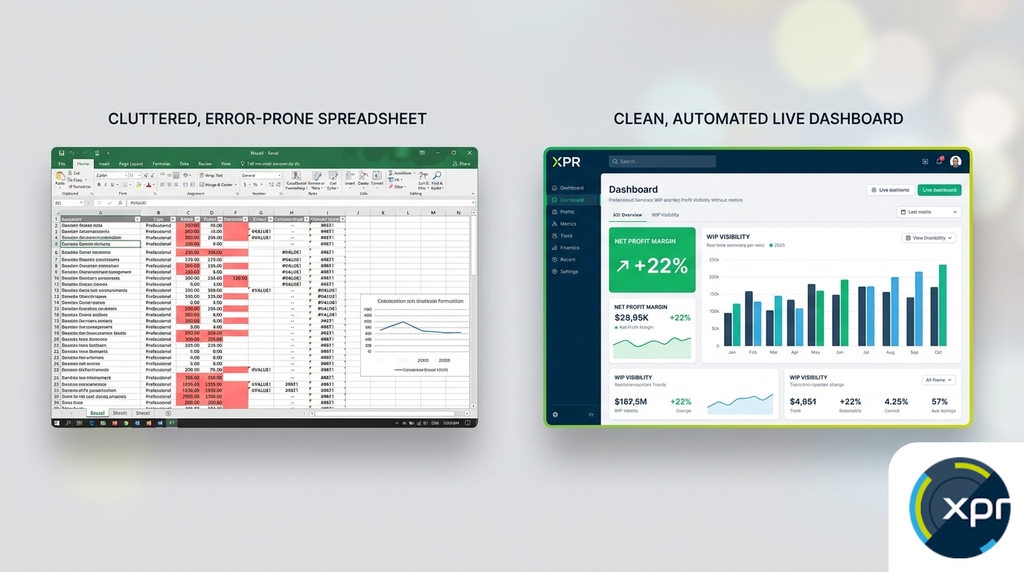
The most visible cost is finance team time: days each month spent exporting from the CRM, the time-recording system and the accounting platform, then cleaning rows and correcting formats to produce a static document. The traditional process is a web of spreadsheets – one person pulls billing, another pulls payroll, a third stitches them together with lookups and manual entry. It is slow, and it is fragile. A single broken formula can send a partner into a strategic decision on the wrong numbers, and nobody will know until the following quarter.
The larger cost is the lost window. If a project goes over budget in week two but the report lands in the middle of the following month, four weeks of opportunity to act have gone. You cannot request an overage approval or change the resourcing mix once the hours are already spent.
There is an organisational cost too. Finance treats the numbers as a historical record; practice leaders need them as a navigation instrument. When those two views diverge, trust in the data erodes, and leaders fall back on instinct. A single live source removes the argument entirely, because everyone is looking at the same figures at the same moment.
Automating the data flow also changes what the finance function is for. A team that spends forty hours a month assembling reports can spend those hours interpreting them instead – moving finance from back-office cost centre to a genuine source of commercial insight.
Why WIP is your firm’s earliest warning system
Work in progress is the value of work performed but not yet invoiced. In a healthy firm it flows steadily into receivables. When it accumulates, it is signalling a bottleneck – approvals sitting with project managers, billing milestones missed, or work being delivered that was never in the scope of the engagement.
Without live visibility, those bottlenecks stay hidden inside healthy-looking averages. A team can be 90 per cent utilised while very little of that effort converts to billable revenue, which means the firm is effectively working with sub optimum, which in turn affects the cash flow. Utilisation and realisation together tell you whether being busy is profitable; we cover that relationship in detail in our guide to utilisation vs realisation. WIP tells you whether the profitable work is actually turning into cash.
Live tracking lets you age WIP by project, by partner or employee level, by work type and by department:
| What the data shows | What it usually means | Action available this week |
|---|---|---|
| WIP rising while utilisation is flat | Billing has stalled – missed milestones or approvals queued | Chase approvals; release the bill |
| WIP concentrated on one matter | Scope creep, or a disputed deliverable | Raise scope with the client before more time is sunk |
| WIP ageing beyond 30 days | Recoverability declining; write-off risk building | Investigate and bill, or reserve deliberately rather than by surprise |
| WIP high with strong utilisation | Growth outpacing billing capacity | Add billing resource before lock-up worsens |
When you can see that a single project holds £50,000 of unbilled time more than 30 days old, you can establish immediately whether there is a client dispute or simply a missed billing milestone. That is what keeps cash flow predictable and prevents the quarter-end write-offs that occur when aged WIP is finally judged uncollectable.
Real-time net profit: moving beyond revenue
Revenue is a vanity metric without a clear view of what it cost to generate. Most firms can state top-line revenue at any moment; net profit is a different matter, because it requires connecting revenue to delivery costs – salaries, overheads and third-party expenses.
Seen live, margin becomes something you can steer rather than report. Bring an expensive contractor onto an engagement and the effect on that project’s profitability should be visible immediately. If realisation slips on a fixed-fee matter, the dashboard should show the margin consequence the same week, not six weeks later.
For a Partner or a COO, this is what makes resource allocation defensible. A practice group with strong revenue and a contracting margin is a pricing or staffing-mix problem, and identifying which requires seeing both numbers side by side, on demand.
What changes on Monday morning
With a live dashboard, the partner meeting stops being an argument about whose spreadsheet is correct. Everyone views the same numbers: utilisation, realisation, WIP and net profit in one place, before the first coffee is finished.
The practical effect is early intervention. A Partner or COO can quickly identify when a team is overutilised while projects show weak realisation, determining whether the team requires additional support or if the scope has drifted beyond the engagement letter. Meanwhile, a Finance Director can review the cash position and projected billings for the week without requesting a manual update. With full visibility into resources, marketing spend, and sales, leadership can direct decisions in the most effective way.
Most importantly, the question changes. Instead of asking what happened last month, leadership asks what to do this week. In a market where margins are thin and talent is expensive, that shift from historical accounting to forward-looking management is decisive.

How XPR Data delivers this in days
Professional services firms shouldn’t have to wait six months or spend hundreds of thousands of pounds to gain visibility into their performance. We unify your time, billing, practice management, and finance systems into a single source of truth — built on three core principles:
-
- Fast implementation: We deploy a live dashboard in days, not months, delivering value while project momentum is high.
-
- Predictable pricing: A flat annual fee with no usage-based surprises. Unlike credit, or capacity-based platforms where costs increase with every user and refresh, our costs stay fixed.
-
- Flexibility and ownership: We integrate seamlessly with your existing tools so your team’s workflow doesn’t have to change. You retain total data ownership and full vendor freedom, easily switching between AI models like Claude or OpenAI as technology evolves.
Frequently asked questions
How is this different from the reporting in our practice management software?
Practice management tools record data well but rarely visualise it across systems. Most cannot pull in external costs or CRM data, which means they can show you WIP but not a full net profit picture. We unify all your systems rather than reporting on one.
Do we need a large IT team to maintain it?
No. We carry the maintenance burden for the integrations and data pipelines, so it does not become a standing commitment for your internal team.
Can we customise the KPIs?
Yes. We start from core metrics such as WIP, realisation and net profit, and build the view around how your firm actually operates – by partner, by office or by service line.
What if we change accounting software next year?
Because we act as an independent integration layer, a change of finance system means updating a connection rather than rebuilding. Your historical data and dashboards remain intact.
Stop reporting on the past
Waiting for month-end has been accepted as a necessary evil in professional services for a long time. It no longer is. Live WIP visibility and real-time net profit tracking give a leadership team the ability to manage the firm with precision rather than hindsight – and the transition takes days, not a multi-year programme.
Ready to see your firm’s numbers as they actually are? Contact XPR Data to turn your practice management and finance data into a single live dashboard.
Nigel, Cesar & Martin